
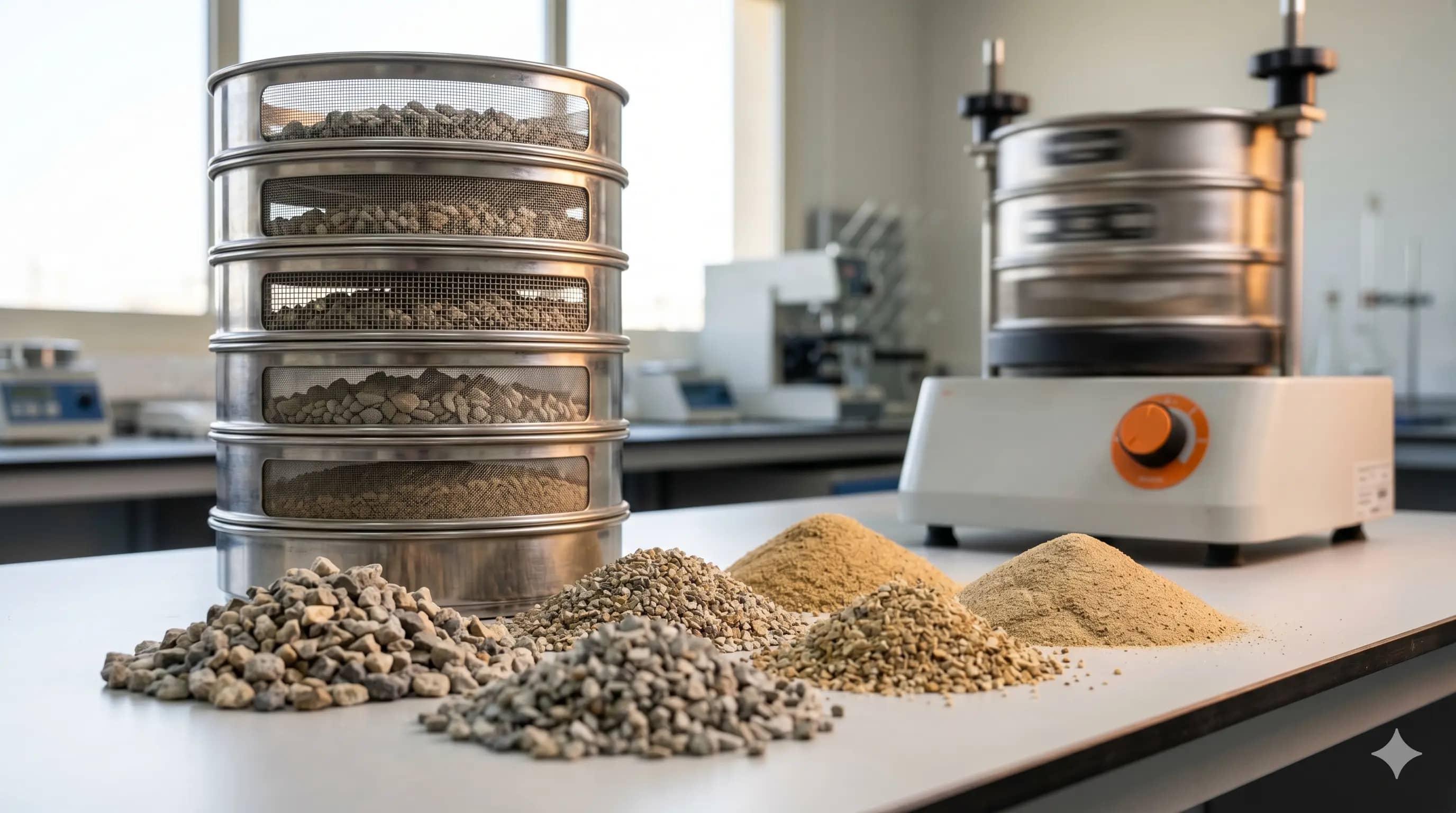
Aggregate is one of the core components of concrete and asphalt mixes, making up roughly 60% to 80% of concrete volume. Its quality — whether sand or gravel — directly affects the strength, durability, and service life of structures.
At ASAS Lab we provide a complete range of aggregate testing services in line with accredited standards to ensure every material matches project requirements.
What Is Aggregate?
Aggregate is the granular material used in construction, and it includes:
- Fine aggregate (sand)
- Coarse aggregate (gravel or crushed stone)
Aggregate is used to produce concrete, roadworks and asphalt mixes, backfill, and many other structural applications.
Why Aggregate Testing Matters
Aggregate testing helps to:
- Confirm materials conform to technical specifications.
- Improve concrete quality and strength.
- Reduce the likelihood of cracking and shrinkage.
- Ensure long-term structural stability.
- Avoid materials containing impurities or harmful substances.
Fine Aggregate (Sand) Testing
Sand is one of the most important concrete components, so it undergoes several tests to verify its quality:
1. Sieve Analysis of Sand
Determines the particle-size grading of the sand and confirms its suitability for concrete mixes.
2. Fines / Material Finer Than #200
Measures the proportion of silt, dust, and fine impurities that can affect concrete cohesion.
3. Specific Gravity & Absorption
Helps define sand properties and their impact on concrete mix design.
Coarse Aggregate (Gravel) Testing
Gravel — the coarse aggregate — carries loads inside concrete, so its quality must be verified before use:
1. Sieve Analysis of Coarse Aggregate
Determines particle-size distribution and conformity with specifications.
2. Los Angeles Abrasion Test
Measures the gravel's resistance to abrasion and wear during service.
3. Specific Gravity & Absorption
Evaluates aggregate properties and their effect on concrete performance.
4. Deleterious Materials & Impurities
Detects organic or clay-like materials that may harm concrete quality.
Aggregate Tests & Standards
| Test | Standard | Purpose |
|---|---|---|
| Sieve Analysis | ASTM C136 | Determine particle-size grading |
| Fines (passing #200) | ASTM C117 | Measure silt & dust content |
| Specific Gravity & Absorption | ASTM C127 / C128 | Aggregate properties & mix design |
| Los Angeles Abrasion | ASTM C131 | Resistance to abrasion & breakdown |
| Organic Impurities | ASTM C40 | Detect harmful impurities |
Characteristics of Good Aggregate
Aggregate used in projects should have the following properties:
- Free of organic matter and harmful impurities.
- Properly graded by particle size.
- High resistance to abrasion and breakdown.
- Low water absorption.
- Conforms to accredited standard specifications.
Engineering tip: Choosing spec-compliant aggregate lowers future maintenance costs and extends structure life. Test aggregate before pouring, not after — correcting a concrete mix after placement is far harder and more expensive.
The Role of Labs in Ensuring Aggregate Quality
Engineering laboratories play a key role in evaluating sand and gravel quality by performing laboratory and field tests and issuing precise technical reports that help engineers and consultants make the right decisions.
At ASAS Lab, all aggregate tests are carried out using calibrated equipment and specialized technicians across our branches in Jeddah, Riyadh, Makkah, Madinah, and Qassim — ensuring accurate, reliable results.
Conclusion
Aggregate testing, sand testing, and gravel quality evaluation are essential steps to ensure concrete quality and structural safety. By performing the necessary tests and confirming material conformity, structural risks are reduced and the highest quality levels are achieved.
If you're looking for an accredited lab for aggregate, sand, and gravel testing, ASAS Lab provides complete inspection services and precise engineering reports to the highest accredited standards.