
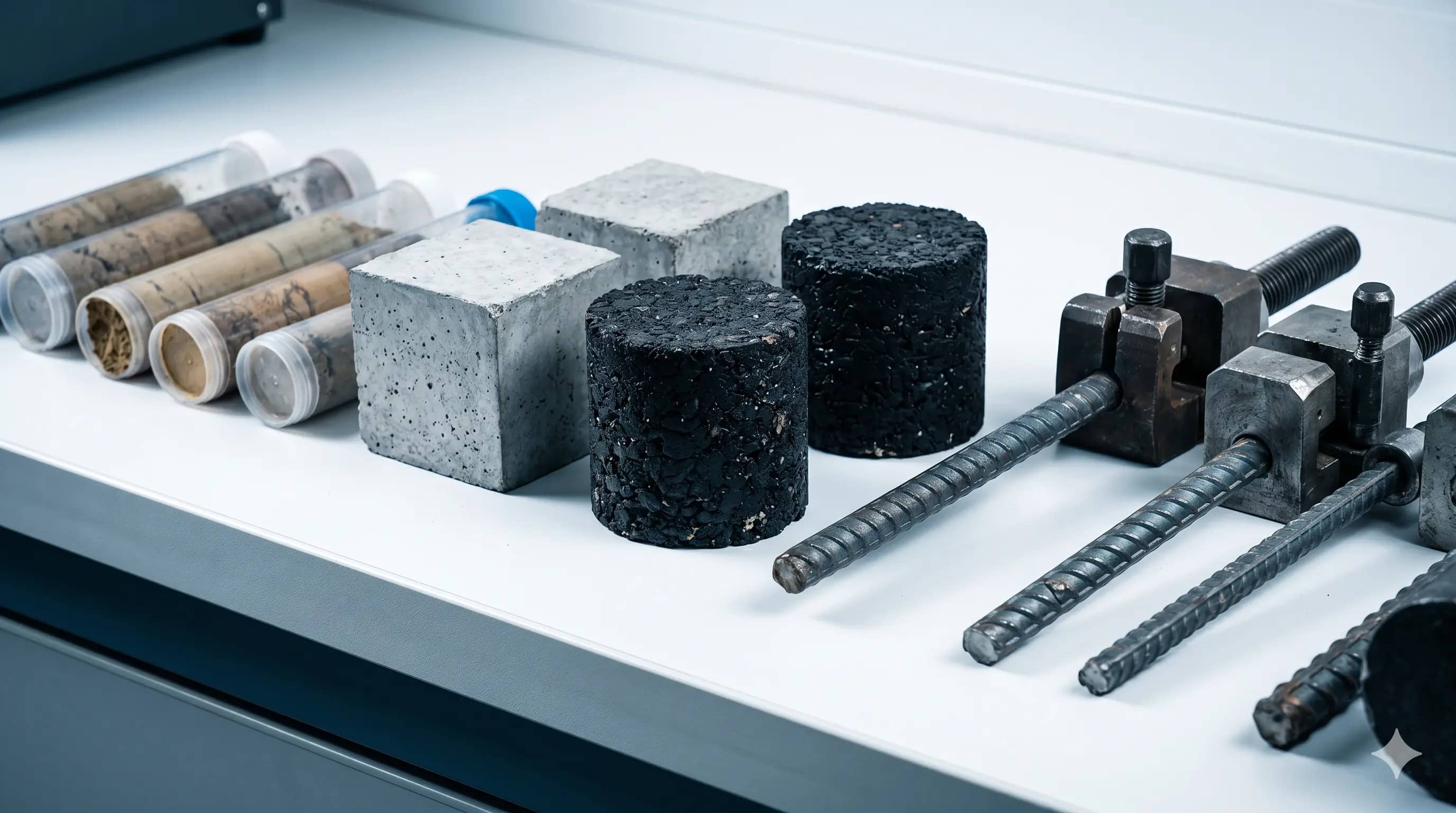
📋 Quick Summary
- 6 main types of engineering tests cover every phase of a construction project
- Soil testing is the foundation — performed before any design or construction begins
- Concrete, rebar, asphalt, and aggregates each require independent testing protocols
- All tests must be conducted in an accredited lab for official acceptance
Behind every successful construction project lies a comprehensive system of engineering tests that ensure material quality and safe execution. Building without testing is like building on air — you never know when it will fail.
This guide covers the types of engineering tests required for construction projects in Saudi Arabia, the approved standards for each type, and when each test is mandatory.
1. Soil Testing
Soil testing is the first and most fundamental step in any construction project. Before drawing a single design, you need to know the nature of the soil that will support your structure.
| Test | Purpose | Standard |
|---|---|---|
| SPT Test | Soil bearing capacity at depth | ASTM D1586 |
| CBR Test | Soil resistance to load | ASTM D1883 |
| Particle Size Analysis | Soil classification (sand, silt, clay) | ASTM D422 |
| Atterberg Limits | Soil sensitivity to water | ASTM D4318 |
| Proctor Compaction | Maximum dry density | ASTM D698 |
ASAS Lab performs soil tests in Jeddah, Makkah, Riyadh, Madinah, and Qassim.
2. Concrete Testing
Concrete tests are performed in two stages: before pouring to verify mix design, and after pouring to confirm the required strength is achieved.
- Compressive Strength Test — the most requested test. Performed on 150×150mm cubes at 7 and 28 days. Standard: BS EN 12390-3 or ASTM C39.
- Slump Test — measures fresh concrete consistency and workability before pouring.
- Air Content Test — measures entrapped air percentage in the mix.
- Water Permeability Test — important for structures exposed to moisture.
- Schmidt Hammer (Rebound Hammer) — non-destructive test to estimate in-situ concrete strength.
3. Asphalt Testing
Asphalt tests are essential to ensure quality in roads, driveways, and parking areas:
- Marshall Test — fundamental for asphalt mix design, measuring stability and flow. Standard: ASTM D6927.
- Penetration Test — measures raw asphalt hardness. Standard: ASTM D5.
- Softening Point — defines the thermal range at which asphalt softens.
- Density and Air Voids — measures void percentage in the compacted asphalt layer.
- Bitumen Extraction — verifies actual bitumen content vs. design specification.
4. Rebar Testing
Rebar is the backbone of reinforced concrete. Rebar testing includes:
- Tensile Test — measures yield strength and ultimate resistance. Standard: ASTM A370.
- Bending Test — verifies flexibility and absence of cracking when bent.
- Rebend Test — tests tolerance to repeated stress.
- Chemical Analysis — verifies carbon, sulfur, and phosphorus ratios per SASO ASTM A615.
5. Aggregate Testing
Aggregate tests (gravel and sand) are critical as they directly affect concrete and asphalt quality:
- Sieve Analysis (Gradation) — determines particle size distribution for optimal mix design.
- Los Angeles Abrasion — measures resistance to crushing and friction.
- Absorption and Density — affects water ratio in concrete mix.
- Harmful Material Content (clay/dust) — must not exceed SASO permitted limits.
6. Chemical Analysis
Chemical analysis of water, soil, and construction materials detects harmful elements that could affect structural durability:
- Mixing Water Analysis — verifies freedom from sulfates, chlorides, and organic matter.
- Soil Sulfate Analysis — critical in Saudi soil containing gypsum deposits.
- Groundwater Analysis — ensures groundwater will not attack foundations or concrete.
- Chloride Content in Concrete — protects against rebar corrosion.
💡 Engineering Tip
Don't wait for a problem before testing. A soil report costs less than 0.1% of total project cost — but a faulty foundation could mean demolishing and rebuilding the entire structure.