

The concrete slump test is a rapid field check of fresh-concrete consistency and workability, based on how far the concrete subsides after the Abrams cone is lifted. It does not measure strength; its result is compared with the project specification or approved mix design.
What Does a Concrete Slump Test Measure?
A slump test indicates how fresh concrete responds to handling and consolidation and can reveal change between deliveries of the same mix. It does not directly measure water content, strength, or durability. The number needs context, so slump belongs within a wider concrete testing program.
Which Equipment and Abrams Cone Dimensions Are Required?
ASTM C143 uses a metal mold, tamping rod, rigid nonabsorbent base, and measure. The Abrams cone is 300 mm high, with a 100 mm top and 200 mm bottom diameter; the round tamping rod is 16 mm in diameter.
- Mold: clean, dampened, and held firmly.
- Rod: straight and round with a rounded end.
- Base: level, rigid, nonabsorbent, and sufficiently large.
- Measure: suitable for the vertical displacement.
A sloping or absorbent base, dirty mold, or unstable footing introduces error unrelated to the concrete.
How Is Fresh Concrete Sampled Before the Test?
Obtain a representative composite sample under ASTM C172 and protect it from contamination, loss, sun, and wind. Start slump testing within five minutes after obtaining the final portion, gently remixing first. Record the truck, location, and sampling times; a random scoop from the first visible discharge is not representative.
How Is the ASTM C143 Slump Test Performed?
Fill the mold in three layers of approximately one-third volume and rod each 25 times. Strike off, then lift vertically in 5±2 seconds. Complete filling through mold removal, without interruption, within 2.5 minutes.
- Dampen the apparatus; place the mold broad end down and hold it firmly.
- Fill and rod the first layer 25 times, distributing strokes across the section.
- Fill and rod the second layer 25 times, penetrating the first slightly.
- Fill and rod the third layer 25 times, penetrating the second slightly.
- Keep concrete above the rim while rodding, then strike off and clear the base.
- Lift smoothly without twisting, invert the mold beside the sample, and measure vertically to the displaced original center of the top surface.
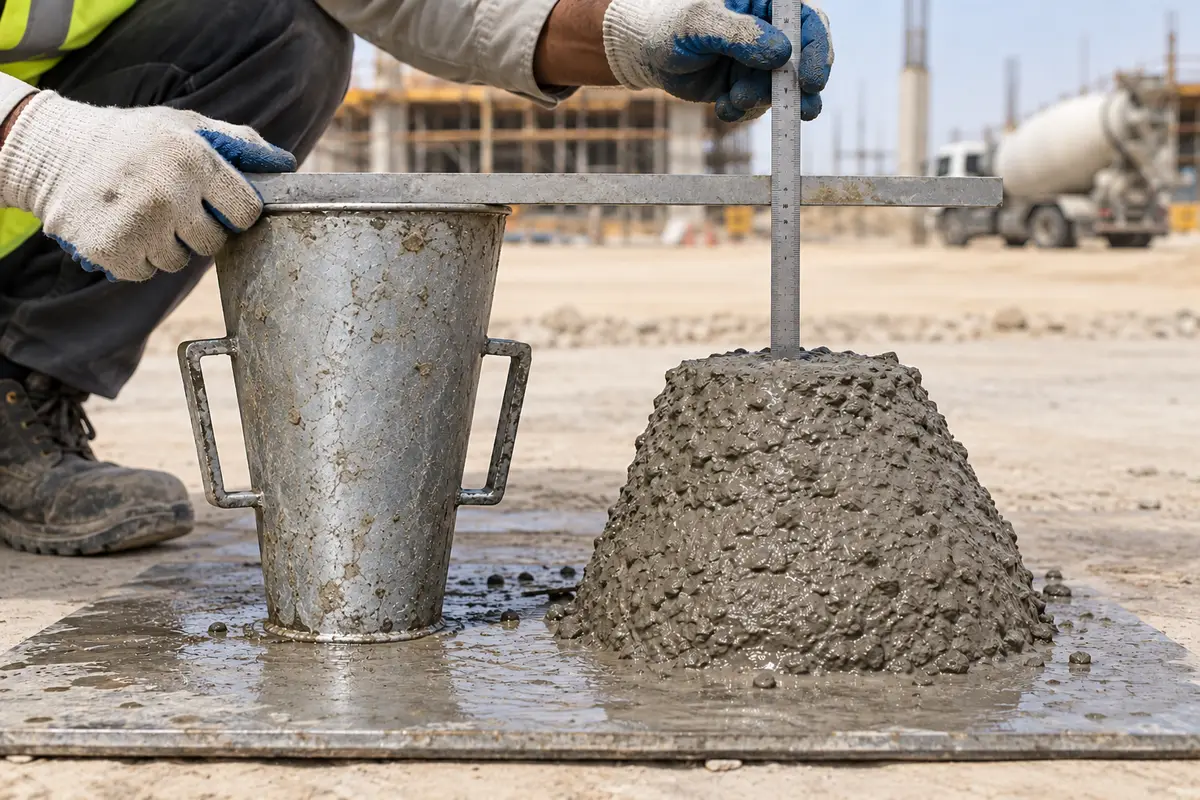
Report the vertical difference to the displaced original center to the nearest 5 mm. Do not measure a random high point or edge.
What Do True, Shear, and Collapse Slump Mean?
The specimen may show true, shear, or collapse slump. Its shape determines whether the number is usable.
| Slump type | Appearance | Action |
|---|---|---|
| True | Subsides while remaining generally cohesive | Record and compare with project requirements |
| Shear | Part slips sideways on an inclined plane | Repeat on another portion; repeated shear indicates insufficient cohesion |
| Collapse | Loses form and spreads substantially | Do not treat as an ordinary result; review method and mix |
Repeat a shear slump on another portion. It cannot be corrected mathematically. Collapse may reflect very fluid concrete or faulty execution, so review the facts.
How Is a Slump Result Accepted?
Accept a result only against the target and tolerance in the project specification or approved mix design. No universal target suits every mix or element. When a result is outside range, review the batch ticket and mix documents and refer the decision to the project-authorized person.
Which Factors Change Concrete Slump?
Water, admixtures, time, temperature, aggregate, mixing, and transport can all change slump. A low result does not automatically mean more water is needed.
- Water and admixtures: affect fluidity by different mechanisms.
- Time and temperature: slump can decline with elapsed time and hot conditions.
- Aggregate: grading, shape, texture, and moisture affect movement and water demand.
- Mixing and transport: duration, drum operation, and delay affect delivered consistency.
Adding water merely to “fix” slump can raise the water-cement ratio and affect strength, durability, and shrinkage. Any permitted adjustment must follow project and supplier procedures, stay within mix limits, be recorded, and be followed by remixing and retesting.
How Does Slump Relate to Other Fresh Tests and Cubes?
Slump complements temperature under ASTM C1064, air content under ASTM C231, and unit weight under ASTM C138; cubes document hardened strength later. Each answers a different question, so compliant slump cannot predict compression results. Connect them to the same sample, truck, and time. See Concrete Testing and Quality Assurance for the wider context.
What Belongs in the Slump Test Field Record?
The record connects the result to the delivery, mix, placement, times, and technician, enabling comparison with specifications and later cube results.
- Project, pour location, date, supplier, truck, ticket, and mix ID.
- Arrival, sampling, start, and measurement times.
- Result, slump type, and any repeat.
- Temperature, companion tests, and cube IDs.
- Documented adjustments, authorization, and site conditions.
Which Site Mistakes Make a Slump Result Unreliable?
Unrepresentative sampling, an uneven base, inconsistent rodding, sideways lifting, and delay all make results unreliable. Other errors include dividing layers by height rather than volume, not penetrating the previous layer, failing to top up lost material, or measuring the highest point. Never round to create compliance, repeat until a preferred value appears, or add undocumented water first.
A sound slump test is a fast, traceable check on fresh-concrete consistency—not a stand-alone judgment of structural strength or safety.