
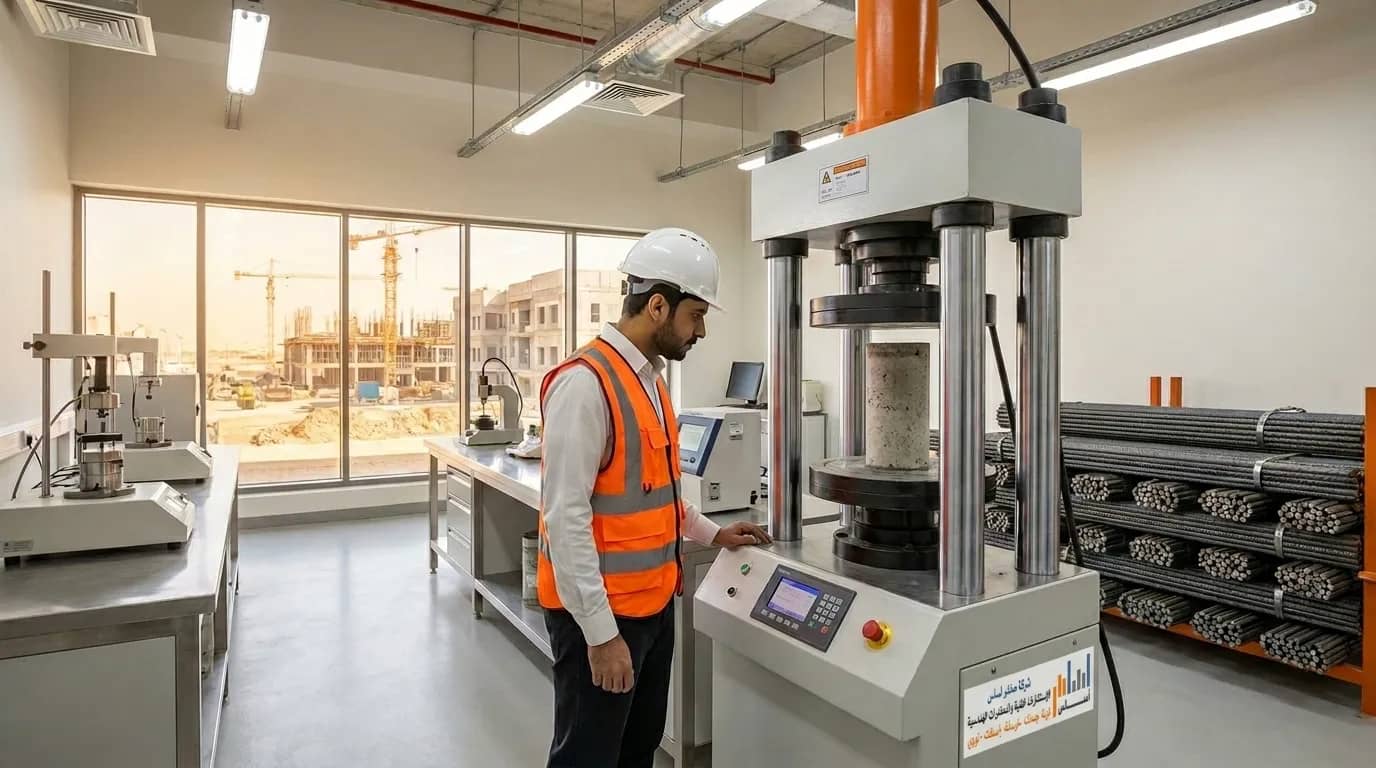
Concrete is the fundamental element in most construction projects. Verifying its quality and load-bearing capacity is an essential step to ensure building safety and longevity — making concrete testing a non-negotiable procedure in any engineering project.
In Jeddah, with its rapid urban expansion, the need for concrete pressure testing and quality verification services has never been more critical, especially given the varying environmental conditions and project types across the city.
What Is Concrete Testing?
Concrete testing encompasses a set of laboratory and field tests performed to verify that the concrete used meets the required engineering specifications.
These tests aim to:
- Verify concrete resistance to applied loads
- Ensure the quality of the concrete mix
- Detect any issues that could affect structural safety
- Confirm compliance with the Saudi Building Code SBC 304
Concrete Pressure Testing and Its Importance
The compressive strength test is the most widely used and important test for evaluating concrete quality.
The test process involves:
- Taking concrete samples during the pouring process
- Preparing specimens (cubes or cylinders) in the laboratory
- Subjecting them to compression using a certified testing machine
- Measuring the maximum load the concrete can bear before failure
Test results help determine:
- ✔️ Actual concrete strength (MPa)
- ✔️ Whether the concrete meets the structural design requirements
- ✔️ The fitness of concrete elements for use
Why Is Concrete Quality Testing Essential?
Neglecting concrete quality testing can lead to serious problems such as:
- Weak structural elements (columns, beams, slabs)
- Premature cracking
- Building settlement or structural failure
- High maintenance and repair costs
Proper testing, on the other hand, helps to:
- ✔️ Extend the building's service life
- ✔️ Reduce structural risks
- ✔️ Ensure construction quality
- ✔️ Protect project investments
- ✔️ Comply with regulatory requirements
Types of Concrete Tests
1. Compressive Strength Test
Measures concrete resistance to loads and verifies it achieves the required design strength per ASTM C39.
2. Slump Test
Measures workability and verifies the mix consistency during pouring, per ASTM C143.
3. Density Test
Determines fresh concrete density and uniformity to verify correct mix proportions.
4. Flexural Strength Test
Confirms the concrete's ability to carry design loads in slabs and floor systems.
Concrete Lab in Jeddah — What to Look For
When selecting a concrete testing lab in Jeddah, ensure it provides:
- Internationally calibrated and certified equipment
- Compliance with ASTM and SBC 304 standards
- Fast issuance of certified reports
- Experienced engineering and technical team
At ASAS Laboratory we offer integrated services including:
- Fresh and hardened concrete testing
- Compressive strength tests at 7 and 28 days
- Laboratory and field quality testing
- Certified reports for government and private projects
Conclusion
Concrete testing is not a routine formality — it is an essential step for ensuring structural safety and construction quality. If you are looking for a concrete testing lab in Jeddah that delivers accurate results and certified reports, ASAS Laboratory provides concrete testing services to the highest standards of quality and professionalism.