
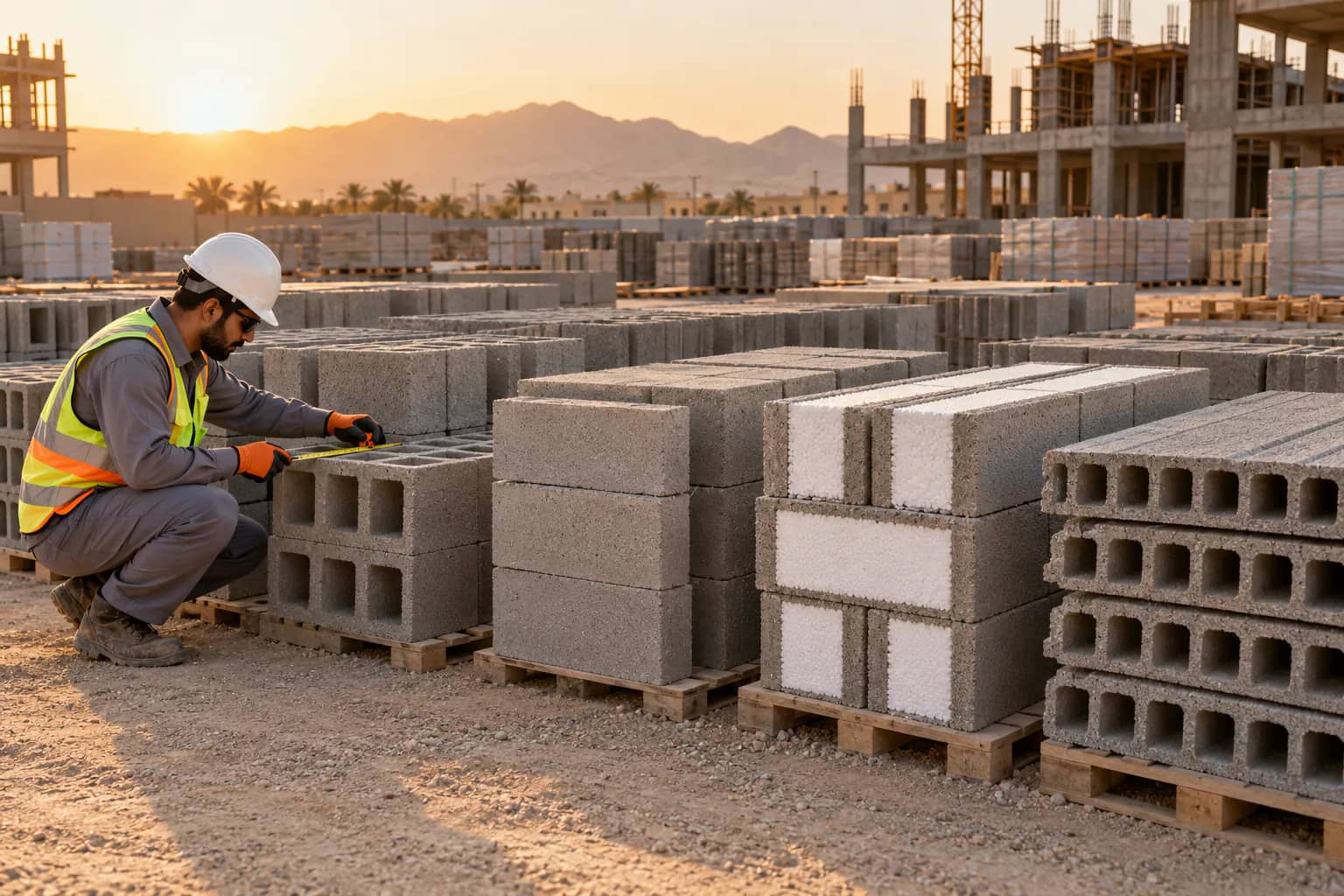
A concrete block is a cement-based masonry unit used for walls or as slab infill, depending on its type. Interlock consists of interlocking concrete pavers for walkways, courtyards, and parking areas. Use determines the suitable size, thickness, and shape, while laboratory tests verify sample strength, absorption, and dimensions before a supply batch is accepted against the project specification.
Types of Cement Blocks and Their Uses
“Cement blocks” does not describe a single product. Manufacturing method, voids, and the structural or architectural purpose all affect selection. The decision begins with the approved drawings and specifications, followed by checking that the delivered product is actually the specified type. The table summarizes the common block categories and their roles.
| Type | Use | Note |
|---|---|---|
| Hollow concrete block | Walls and partitions as designed | Voids reduce material, while unit properties depend on manufacture |
| Solid concrete block | Locations defined by design and specification | Do not substitute it for hollow block, or vice versa, without drawing approval |
| Insulated block | Walls requiring improved thermal insulation | Typically contains a polystyrene core |
| Hourdi block | Infill between ribs in ribbed slabs | Its function differs from a wall block |
The weight of a hollow cement block has no universal figure. It varies by block type, size, mix composition, void arrangement, and manufacturer. Use the supplier's documented data and the actual sample rather than estimating weight from a trade name or thickness alone.
Common Cement Block Sizes in Saudi Arabia
Saudi suppliers commonly name cement block sizes by unit thickness: 10, 15, or 20 cm, with a typical 40×20 cm face. This is useful site shorthand, but it does not replace checking the drawing dimensions and measuring delivered units because product details can vary among manufacturers.
| Nominal thickness | Typical face | Typical use |
|---|---|---|
| 10 cm block | 40×20 cm | Light internal partitions where permitted by design |
| 15 cm block | 40×20 cm | Medium-thickness walls and partitions as detailed |
| 20 cm block | 40×20 cm | Thicker walls where required by design |
These uses are indicative, not a substitute for design. A thicker unit is not automatically the best or compliant choice. Selection also depends on wall function, unit type, architectural and structural details, and the insulation and fire provisions stated in the project documents.
Insulated Blocks: When Are They Appropriate?
An insulated block contains a polystyrene core intended to improve wall thermal insulation. Its benefit depends on the complete wall assembly rather than the block name alone. Units must work with installation details and with the specified treatment of joints and openings.
It is a logical option when the building specification calls for improved wall thermal performance. When comparing suppliers, visually seeing insulation is not enough. Review type and dimensional conformity, manufacturing consistency, product documents, and required test results. Whether an insulated block is “worth it” depends on the wall and project requirements, not a universal preference.
Hourdi Blocks and Their Role in Ribbed Slabs
A hourdi block is a hollow unit used as infill in ribbed, or hourdi, slabs. Units sit in the spaces between ribs according to the drawing, so their purpose differs from wall blocks. They should be selected for the slab system and designer's details, not merely because a similar-looking unit or size is available.
At delivery, check type, dimensions, and visible condition, then apply the block tests required by the project specification. It is important to distinguish the infill role from that of the concrete slab elements: hourdi blocks are not another name for the cast concrete or load-bearing ribs.
What Is Interlock? Types and Sizes
Interlock means concrete paving units that fit together to form surfaces for walkways, courtyards, and parking areas. Selection depends on the paving location, expected traffic, and drawings. Common interlock types include rectangular, I-shaped, and S-shaped or zigzag pavers. Each creates a different visual pattern and interlocking arrangement.
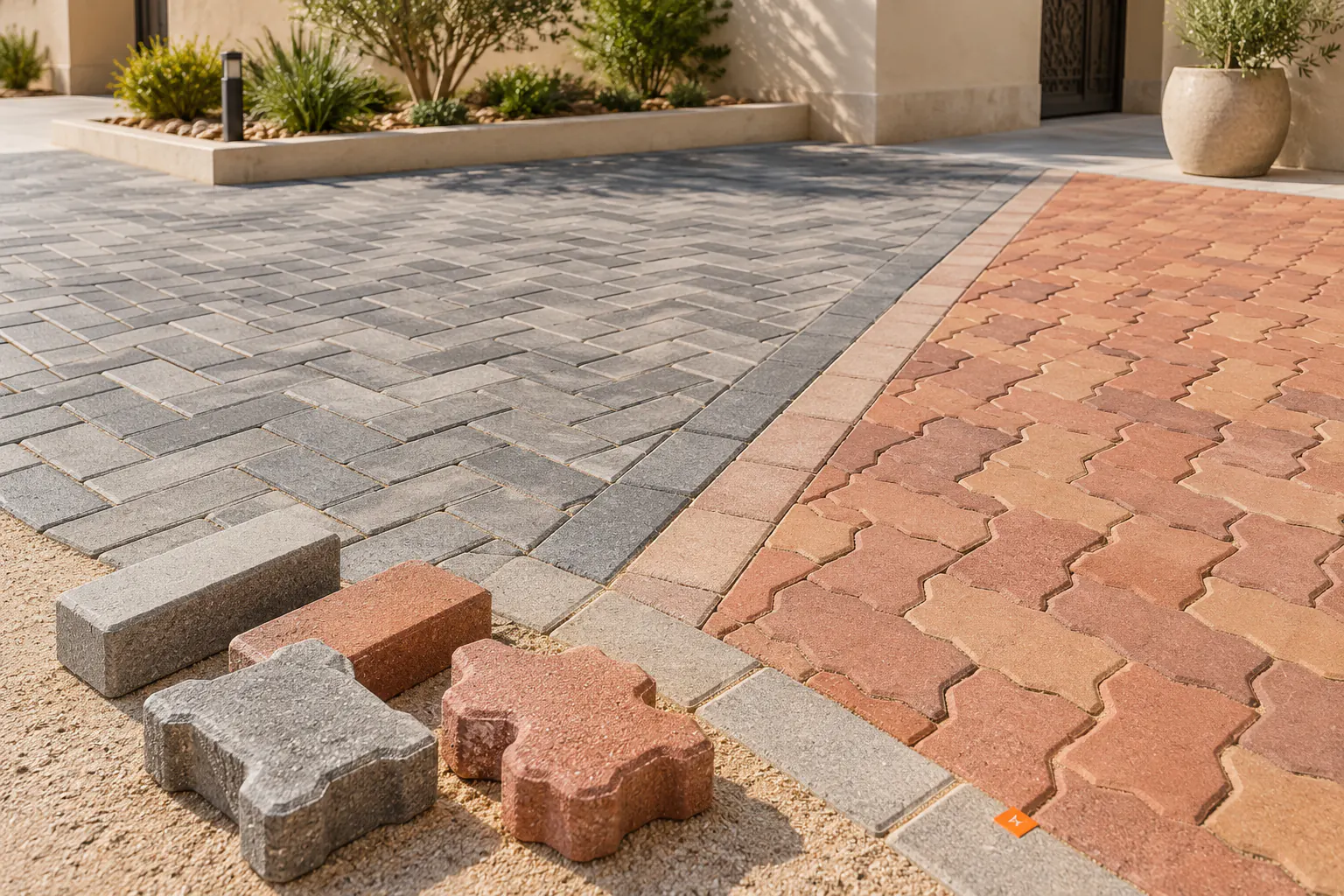
For interlock sizes, thickness commonly follows the application: 6 cm is common in pedestrian areas, while 8 cm is common in vehicle areas. Length and width vary with shape and manufacturer. These common dimensions are not final acceptance criteria; the project specification and consultant remain the references for selection and approval.
Successful paving is not determined by shape or color alone. Consistent dimensions support uniform joints and interlocking, while tests reveal properties of a sample from the delivered batch. A visually attractive display sample therefore cannot establish that every later shipment has the same characteristics.
Curbstones and Paving Edge Restraint
Curbstones define paving edges and separate a walkway or paved area from its surroundings. They establish the end of the interlock surface and help control the edge as part of the installation details. Their shape and dimensions follow the drawing, and delivered units are checked for uniformity, intact edges, and conformity with the required specification.
When interlock and curbstones arrive together, identify every sample by product, batch, and intended location. This prevents confusion between products that look similar but belong to different areas and makes the receiving decision traceable.
Block and Interlock Tests Before Acceptance
Cement block and interlock tests measure properties of representative samples from a supply batch. Results are then compared with the specification required by the project or consultant. The blocks, interlock and curbstones testing service includes the following examinations:

- Compressive strength — ASTM C140: measures the maximum load a block or interlock sample withstands before fracture.
- Water absorption — ASTM C140: measures water absorbed by a block or curbstone sample and helps assess product porosity.
- Dimensions: verifies block or interlock dimensions against the specification, supporting accurate installation and consistent units.
- Fire resistance for blocks: evaluates cement block resistance to fire and high heat when safety requirements call for a wall fire rating.
- Flexural strength for interlock — ASTM C880: measures paver behavior under bending and traffic loading.
- Modulus of rupture for interlock — ASTM C99: measures resistance to fracture under bending and complements the flexural assessment.
A result cannot be interpreted without sample identity. Record the manufacturer, product type, size, batch number, and intended use, then follow the project's approved sampling plan. After testing, compare the measured values with the limits in the consultant's required specification; one acceptance value cannot be generalized across all products and uses.
Blocks and paving products may form part of a wider quality-control program alongside concrete testing. Each material, however, has its own samples, tests, and reports, and a result for one material cannot be used to judge another.
How to Choose the Best Block or Interlock for a Project
The best block is not a fixed market label. It is the product that matches the element's function and the project documents. Start with the drawing: is the unit for a wall, partition, or slab infill? Are thermal insulation or fire-resistance requirements stated? Match unit type, thickness, and dimensions to the specification, and never substitute hollow for solid or ordinary for insulated merely because it is available.
For interlock, first establish whether the area serves pedestrians or vehicles, then review the specified thickness, shape, paving pattern, and curbstones. Require the supplier to identify every batch, segregate visibly inconsistent or damaged units, and send representative samples for testing before approving the quantity.
- Review drawings and specifications before ordering material.
- Record the manufacturer, type, size, and supply batch number.
- Visually check unit and edge consistency and prevent product mixing.
- Coordinate representative sampling under project requirements.
- Compare the laboratory report with the project specification and consultant's decision before acceptance.
This process bases selection on application, measurement, and testing rather than trade name or appearance alone. It produces a clearer supply decision and a quality record connecting installed material to the batch that was tested.