
Choosing the right foundation type is one of the most critical engineering decisions affecting the safety and stability of any construction project. While some assume the choice between a raft foundation and isolated footings comes down to cost, the decisive factor is always the soil investigation report.
The report defines soil properties with precision, giving the engineer the data needed to make the correct decision — one that guarantees structural safety for the long term.
What Are Isolated Footings?
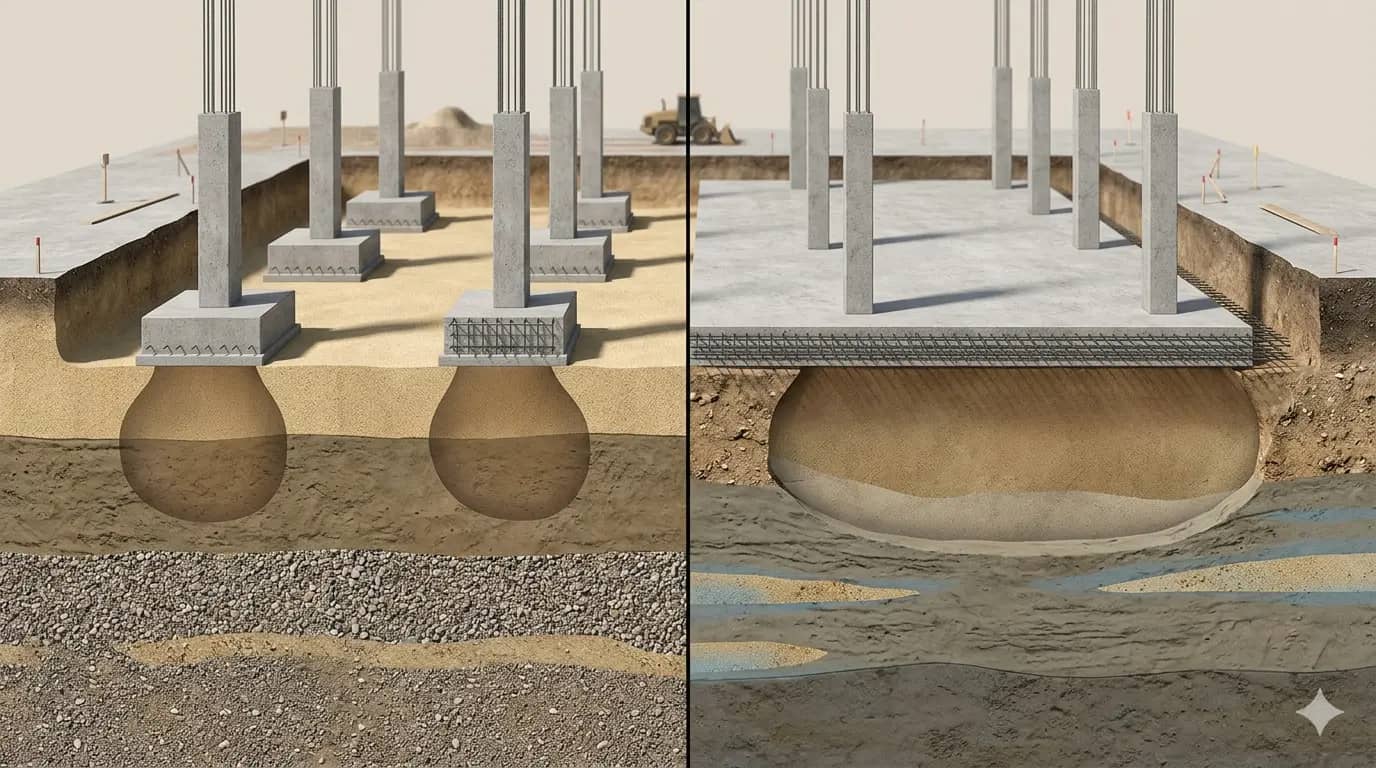
Isolated footings are individual concrete bases constructed beneath each column, transferring loads from the columns directly to the soil.
This foundation type is one of the most common solutions in projects with good soil conditions. It is straightforward to construct and more cost-effective than other systems.
However, its effectiveness depends heavily on soil quality. Any weakness or non-uniformity in soil layers can lead to problems such as differential settlement.
What Is a Raft Foundation?
A raft foundation (mat foundation) is a reinforced concrete slab that covers the full footprint of the building. It distributes loads over a large soil area rather than concentrating them at discrete points.
This foundation type is used when soil is weak or non-uniform. It reduces the effects of settlement and deformation, providing greater overall structural stability.
Although a raft foundation typically costs more, it is the safer choice in many scenarios where isolated footings would be inadequate.
How Does the Soil Report Determine the Right Foundation?
The soil report is the primary reference engineers rely on when selecting a foundation type. It contains critical data such as:
- Soil bearing capacity
- Nature and uniformity of soil layers
- Groundwater level
- Field test results — including SPT (Standard Penetration Test)
- Chemical analysis of soil
Based on this data, the decision follows the actual site conditions:
- When soil is strong and uniform with adequate bearing capacity → Isolated footings are the economical and practical solution
- When soil is weak or non-uniform, or groundwater is high → a Raft foundation is the safer choice
The Core Difference Between the Two Systems
The fundamental difference between a raft foundation and isolated footings is not just shape or cost — it is how each system interacts with the soil:
- Isolated footings: Transfer loads directly to specific points — they need strong soil to work correctly.
- Raft foundation: Spreads loads across the entire base area — it compensates for weak or variable soil.
Common Mistakes in Foundation Selection
In some projects, the foundation type is chosen without rigorous analysis — leading to significant problems later. The most common mistakes include:
- Choosing isolated footings to reduce costs despite unsuitable soil
- Ignoring the soil report and relying on experience alone
- Failing to account for groundwater levels
- Underestimating the expected settlement
These mistakes typically result in:
- Structural cracking
- Foundation settlement
- Costly reconstruction of part of the project
The Role of Engineering Labs in Supporting the Decision
Engineering laboratories play a fundamental role in determining the appropriate foundation type. Their contribution goes beyond running tests — it includes analysing results and providing precise recommendations.
At Asas Laboratory, soil investigation reports are prepared to international standards, delivering clear engineering insight that helps designers and contractors choose the right solution for each site and minimise risk before construction begins.
Summary
The choice between a raft foundation and isolated footings is not arbitrary — it is directly driven by soil test results.
- Strong soil → Isolated footings are the most cost-effective and efficient choice
- Weak or unstable soil → Raft foundation provides the required safety and stability
In all cases, the true foundation of any successful project is accurate data and sound engineering analysis before work begins.