
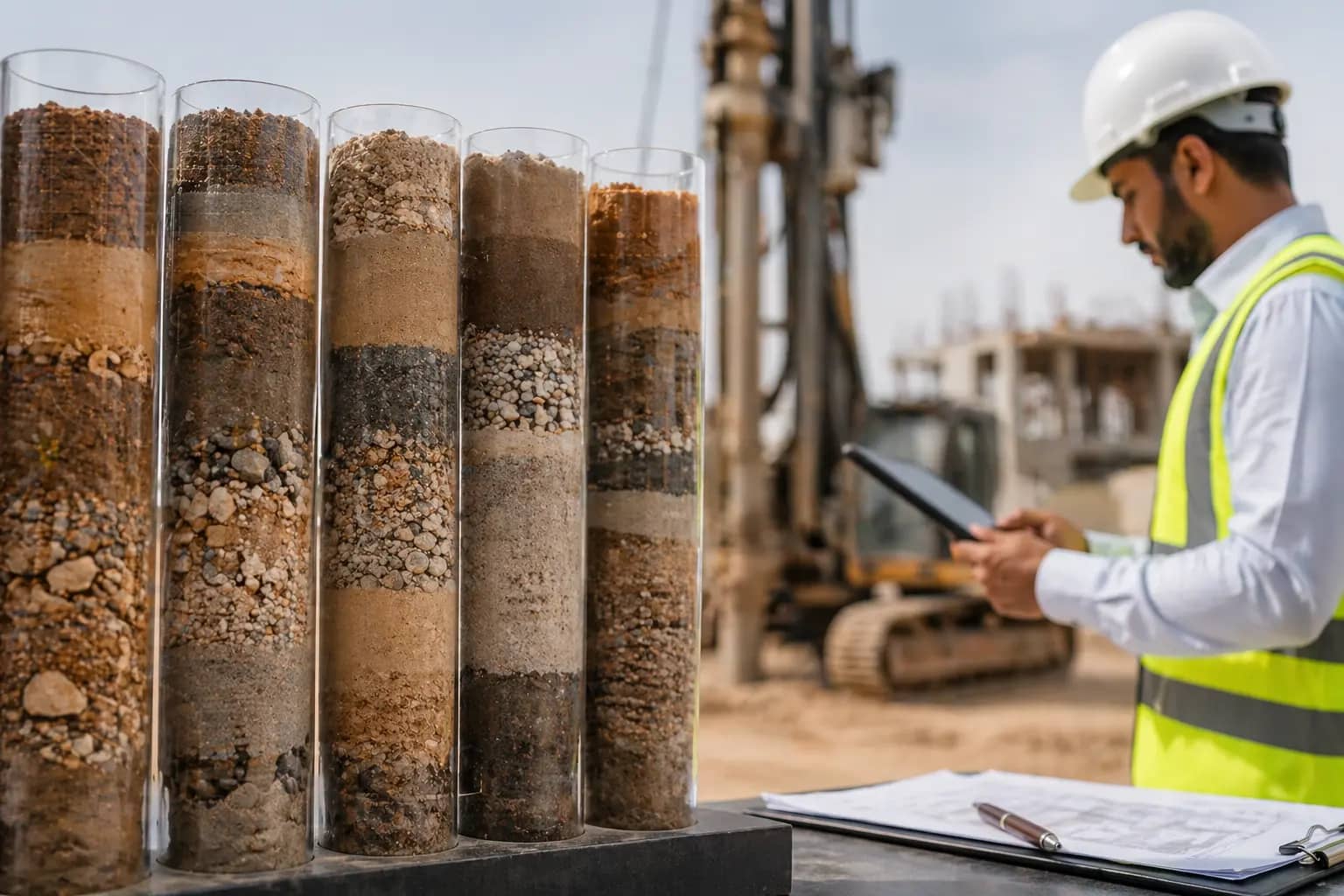
When planning any construction project, the first true step toward ensuring safety and stability is soil testing services. Soil is what carries the entire structure, and any error in its assessment can lead to serious problems — settlement, cracking, or even foundation failure.
What Is Soil Testing for Construction?
Soil testing is a set of field and laboratory tests performed to determine the physical and mechanical properties of the soil, such as bearing capacity, density, moisture content, soil type, and groundwater level. These findings enable engineers to make accurate decisions about foundation design, type, and depth.
Most Important Soil Tests Used in Construction Projects
Standard Penetration Test (SPT)
One of the most widely used in-situ tests. A hammer drops on a soil sampler to measure penetration resistance — used to determine soil strength, estimate bearing capacity, and select foundation depth.
Nuclear Field Density Test
Measures soil density after compaction to verify the required compaction ratio is achieved, ensuring fill quality and reducing settlement risk.
Sieve Analysis
Determines particle size distribution — a key method shared with aggregate testing — to classify the soil and define its engineering characteristics.
Atterberg Limits
Determines the plastic and liquid limits of cohesive soils to evaluate swelling/shrinkage behaviour and stability.
Direct Shear Test
Measures shear strength to support design of foundations, retaining walls, and slope stability analysis.
Why Choose ASAS Laboratory for Soil Testing?
ASAS Laboratory provides soil and materials testing with state-of-the-art equipment and the highest quality standards — certified reports, fast turnaround, and technical support for engineers and contractors across Saudi Arabia.