
📋 Quick Summary
- Rebar testing covers 4 main tests: tensile, bending, rebend, and chemical analysis
- Saudi standard: SASO ASTM A615 (and ASTM A706 for seismic zones)
- Grade 60 is the most widely used rebar in Saudi construction (yield strength: 420 MPa)
- Non-compliant rebar = cracks + settlement + reduced lifespan + collapse risk
Reinforcing steel (rebar) is one of the most critical elements in any construction project — it is what allows reinforced concrete to resist tensile forces, bending, and applied loads. This makes proper rebar testing an essential step before any pouring or construction work begins.
In Saudi Arabia, rebar products are subject to strict standards set by the Saudi Standards, Metrology, and Quality Organization (SASO), in addition to international standards such as ASTM.
What Is Rebar Testing?
Rebar testing is a set of laboratory and field tests performed to verify that the steel used in a project meets the required mechanical and engineering specifications per Saudi Building Code SBC 304.
Testing aims to:
- Verify rebar quality before use
- Confirm compliance with Saudi and international standards
- Reduce risks of structural cracking and failure
- Protect long-term structural integrity
- Obtain certified reports accepted by official authorities
Key Rebar Tests
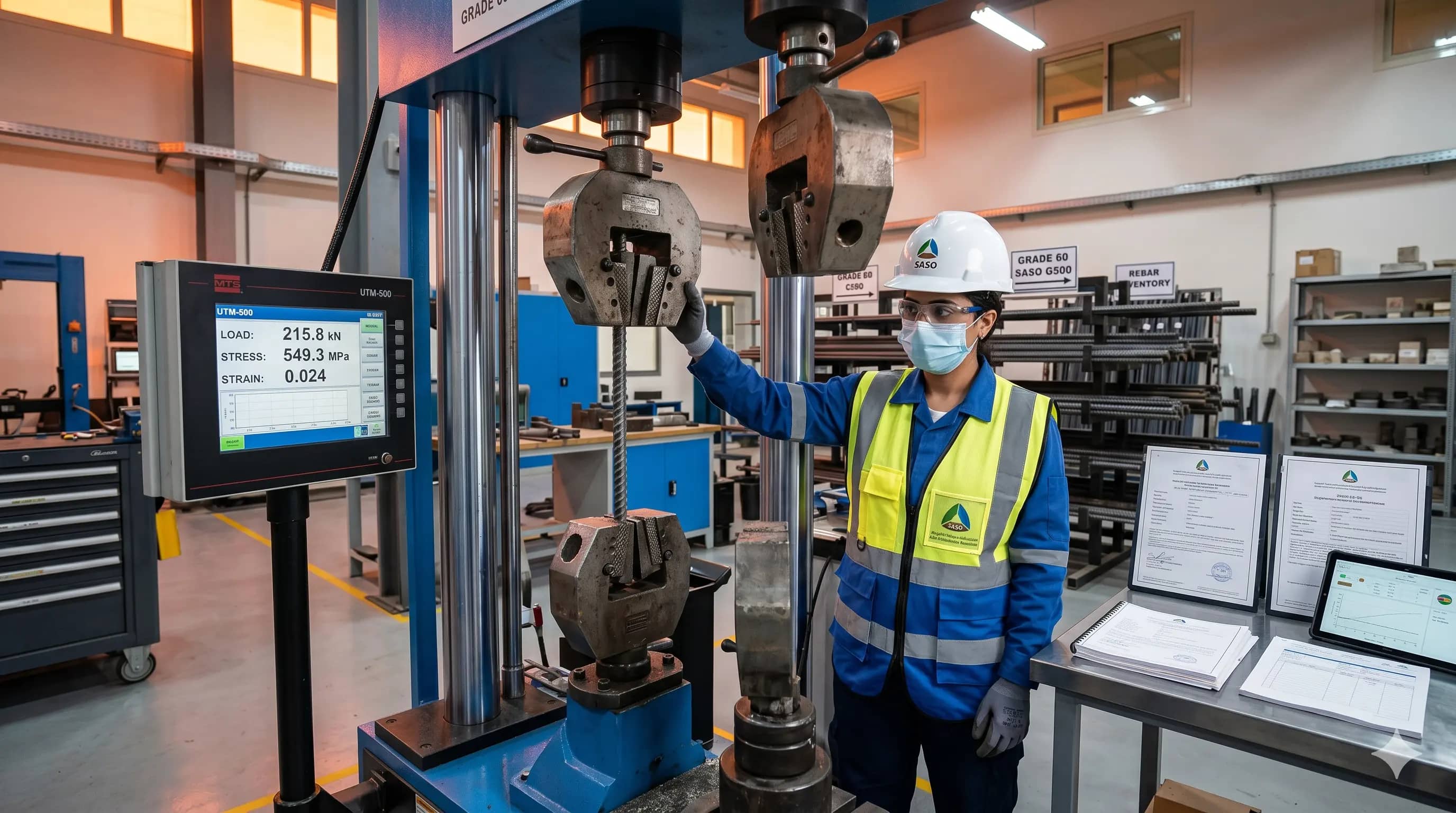
1. Tensile Test
The most important rebar test per ASTM A370, measuring:
- Yield Strength — the force at which permanent deformation begins
- Ultimate Tensile Strength — maximum load before fracture
- Elongation — indicator of rebar flexibility and formability
2. Bending Test
A rebar specimen is bent to 180° to verify:
- Flexibility without fracture
- Absence of cracks or surface defects
- Ability to withstand forming during construction
3. Rebend Test
Used to verify tolerance to repeated stress cycles — required especially in infrastructure, bridge, and seismic projects.
4. Chemical Analysis
Full chemical analysis of the steel composition to determine:
- Carbon (C) — directly affects weldability
- Manganese (Mn) — improves toughness and hardness
- Sulfur (S) — harmful element that reduces ductility
- Phosphorus (P) — harmful element that weakens performance in cold environments
Rebar Standards Approved in Saudi Arabia
SASO ASTM A615
The primary standard for carbon steel rebar in Saudi Arabia. It specifies:
- Acceptable rebar grades (Grade 40 / Grade 60 / Grade 80)
- Minimum yield and ultimate tensile strength
- Acceptable elongation ratios
- Dimensions and weights per diameter
ASTM A706
Used for weldable rebar suited to seismic-zone projects and structures with special requirements.
Rebar Grades Used in Saudi Arabia
| Grade | Yield Strength | Common Use |
|---|---|---|
| Grade 40 | 280 MPa | Light and small residential projects |
| Grade 60 ⭐ | 420 MPa | Most common — majority of construction projects |
| Grade 80 | 550 MPa | Very high-load structures |
Why Is Rebar Testing Essential?
Using non-compliant rebar can lead to:
- Weak structural elements and deteriorating performance
- Premature cracking in reinforced concrete
- Reduced service life of the building
- Increased risk of partial or total collapse
- Project rejection by supervisory authorities
Certified testing, on the other hand, ensures:
- ✔️ Higher construction quality and structural safety
- ✔️ Risk reduction and investment protection
- ✔️ Regulatory approvals from official bodies
- ✔️ Longer building lifespan and lower maintenance costs
ASAS Laboratory — Certified Rebar Testing
At ASAS Laboratory for Technical Consultations and Engineering Laboratories, we conduct all certified rebar tests per SASO and ASTM standards. Our process includes:
- Sampling per approved engineering specifications
- Testing with calibrated equipment per ISO/IEC 17025
- Issuing precise technical reports accepted by municipalities and supervisory bodies
- Verifying compliance with Saudi Code SBC 304
Conclusion
Rebar testing is not a routine formality — it is a fundamental safeguard for the safety and quality of any structure. With Saudi SASO standards and ASTM specifications in place, compliance with rebar testing has become a non-negotiable requirement in modern construction projects.